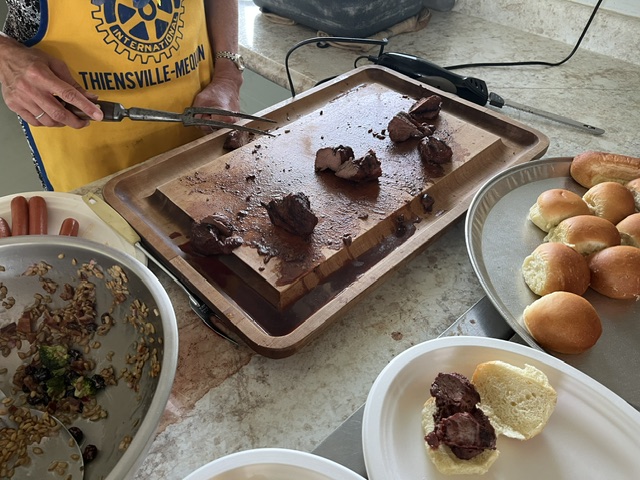
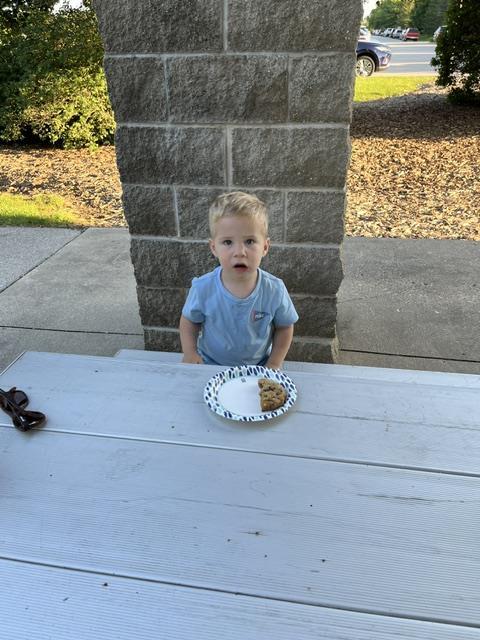
Rotary Family Night was a tremendous success! Thanks to Sandy Custer, his cooking crew, all of the Rotarians who contributed food, drinks, fun activities and fellowship! Always a great way to end the summer.
Kristen Nicholson has dedicated her career to supporting survivors of domestic and sexual violence for nearly 30 years. A survivor of domestic violence herself, she is passionate about helping others find safety, healing, and hope.
Kristen earned dual bachelors degrees in Psychology and Social Science from Alverno College.
She holds a masters degree in Clinical Psychology from the Wisconsin School of Professional Psychology and is a Licensed Professional Counselor (LPC) in Wisconsin. She went on to earn her Master’s Certificate in Non-Profit Management from Northwestern University.
She has been with Advocates of Ozaukee since 2004, serving in a variety of leadership and clinical roles
before becoming Executive Director in 2026.
In addition to leading Advocates of Ozaukee, Kristen has taught for the psychology departments at both Alverno College and Concordia University. She continues to provide counseling to survivors of trauma and is committed to strengthening services and raising awareness for individuals and families impacted by domestic and sexual violence.
Cedarburg Community Pool on Evergreen Ave. Cedarburg, WI
Join us for this family and dog friendly event. As always, it will include a t-shirt and THE best pancake breakfast prepared by our friends at From Scratch Catering.
Date: Saturday, September 26, 2026
Registration................................ 7:00am FUN Run/Walk Start................. 8:00 am
Register for Rotary Connect & Lead 2026 Conference
Get ready to grow your skills, expand your network, and lead with confidence at Rotary Connect & Lead 2026 - a full day of professional development featuring dynamic speakers, interactive workshops, and meaningful networking.
Date: Saturday, September 26, 2026 Time: 8:15 AM – 3:30 PM Location: Concordia University, 12800 N Lake Shore Drive, Mequon
This year's lineup includes:
• Tech Tools: "Catch the Thief: Reclaim Your Day" with Don Griffing - Simple, tool-agnostic strategies to reclaim your focus and stop distractions from stealing your day.
• Leadership: "Managing Volunteers Like a Pro" with David Sakrison - Motivate volunteers without authority, delegate effectively, and avoid burnout.
• Culture: "True Ownership" with Katherine Breuss - Discover how upstream thinking transforms leadership, teams, and organizations from the inside out.
• Emotional Intelligence:"No Is Just an Opportunity" with Alexandria Binanti - Navigate organizational politics and turn pushback into progress.
• Personal Branding with Ben Bauer - Build a brand that reflects your strengths and opens doors.
• Networking: "Networking & Social Capital" with Ben Zang - A proven framework for building relationships that create real opportunities.
• Community Engagement: "From Project to Movement" with Christi Hunter - Turn service projects into partnerships that attract volunteers, sponsors, and lasting impact.
• Effective Communication with Brian Hendricks - Practical tools to communicate with clarity and confidence.
Why attend? This is a fantastic opportunity for professional growth, fresh ideas, and connecting with fellow leaders, whether you're a longtime Rotarian or new to the organization. And good news: the event is open to non-Rotary members too, so feel free to bring a friend or colleague!
Cost: $15 for Rotary Members | $25 for Friends of Rotary (lunch included)
Registration closes September 18 - don't miss out!
In need of more gear to show that you are a true Thiensville--Mequon Rotarian? Look no further than our newly updated Swag Store! Click on the link below to get your quality hats, shirts and pullovers, for both men and women, in a variety of sizes and colors!
For centuries, “X” has marked the spot when we don’t know where exactly the spot is. Its use in algebra to mean an unknown quantity spread into the wider culture, giving “X” an air of mystery, as seen in titles such as The X Files and even the term “X-rays,” named by their discoverer Wilhelm Röntgen in 1895 because he wasn’t quite sure what he’d found.
The idea of “X” marking the spot on pirate treasure maps likely goes back to Robert Louis Stevenson’s Treasure Island, but the letter’s use in math is murkier in origin. So how did “X” come to denote a mystery?
Lost in Translation
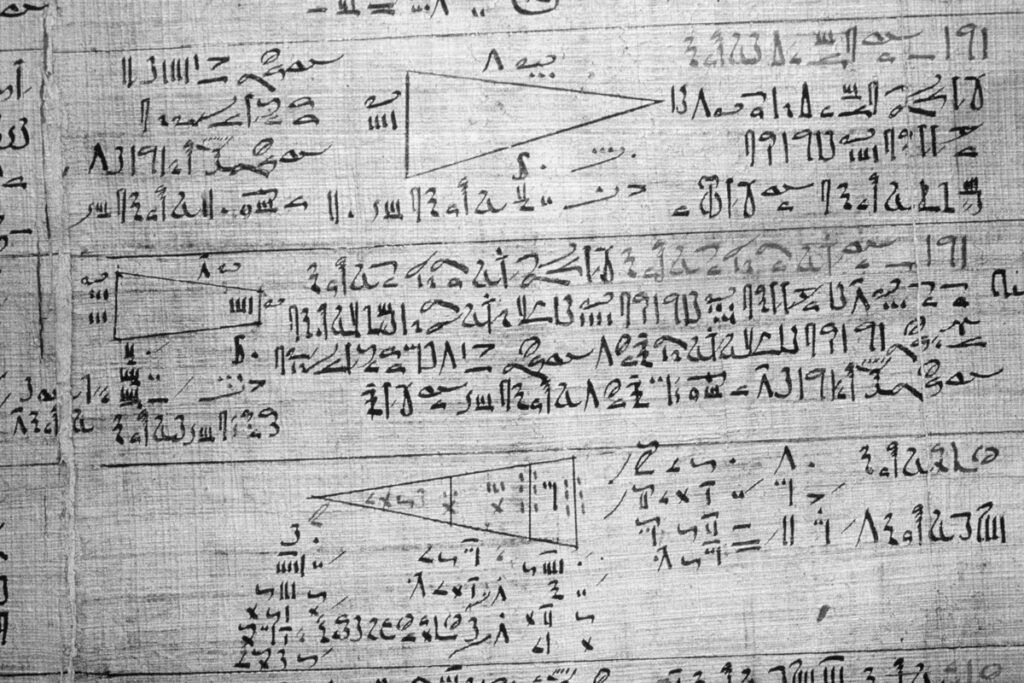
Ancient civilizations used a variety of ways to indicate unknown quantities, but their math problems were generally written out using words, rather than notation. In one ancient Egyptian papyrus, for example, a scribe used the hieroglyphic symbol referred to as aha (which means something like “heap” or “mass”) to denote an unknown quantity. And in ancient Babylonia, a scholar wrote of two unknowns by describing them as the “first silver thing” and the “second silver thing.”
Other systems used colors or coins. There wasn’t one standard word, or symbol, to mean “unknown.”
Algebra flourished during the Islamic Golden Age (750-1258 CE) in modern-day Iraq. Mathematician Muhammad Al-Khwarizmi’s influential ninth-century treatise Kitab al-jabr wal-muqabala, translated into Latin in the 1100s, introduced Arabic numerals to the West (although it’s worth noting they aren’t Arabic in origin, but originally came from India).
The first translations of this treatise, and many other Arabic math manuscripts, happened in 12th-century Spain. But according to one theory behind the origin of “X,” the medieval Spanish translators hit a snag: The Arabic letter shin (ش), which makes a “sh” sound, has no direct Spanish translation. This became a problem because the Arabic word al-shayun, meaning “something” or “the unknown thing,” was frequently used in these manuscripts to mean an unknown quantity, and was abbreviated with the letter shin.
Because the Spanish translators had no equivalent letter for the “sh” sound, they chose the classical Greek letter χ (chi), which makes a “ck” sound, as the equivalent. This later became the Latin “X,” and was eventually adopted by mathematics textbooks.
That’s one theory, anyway. Some scholars argue that Spanish already has an “X,” which has been pronounced in certain times and places with a “sh” sound, which means the translators could have used their own “X” without needing to borrow from Greece.
But not everyone is convinced that Spanish translators are the key to the story of “X."
When in Doubt, Blame Descartes
The Spanish translation story would be more compelling if “X” meant “unknown” in European math manuscripts from the 12th century onward. But it didn’t. Over the next few centuries, Western texts used a smattering of different words and symbols to represent the concept.
A perhaps more plausible theory points to the extremely influential 17th-century French philosopher and mathematician René Descartes, of cogito, ergo sum (“I think, therefore I am”) fame.
In his 1637 work La Géométrie, a foundational text on analytical geometry, Descartes introduced the idea of using the first few letters of the alphabet as stand-ins for known numbers, with the last few letters as stand-ins for unknown numbers. It’s not entirely clear why “X” predominated, but Descartes seems to have preferred it, possibly because of its similarity to a symbol for the unknown used by German writers.
Some scholars also suggest that printing realities came into play: There were more “X’s” to go around in print shops than “Y’s” or “Z’s,” because “X” was more common in French and Latin. It’s not obvious how aware Descartes would have been of this, however.
In the end, the story of “X” may itself remain an unknown. The Arabic translation theory is elegant but difficult to prove, while Descartes’ role is far better documented, even if his reasons for favoring “X” are lost to history. Whatever path the letter took, by the late 17th century it had become firmly established as mathematics’ stand-in for an unknown quantity, before escaping the classroom to become shorthand for mystery itself. Today, whether it appears in an algebra equation, on an X-ray, or in the title of a sci-fi show, “X” still carries the same quiet promise: There’s something here we haven’t solved yet.