I'm a big fan of the "GPS Theory." When you miss a turn, your GPS doesn't judge you, it recalculates. No matter how many detours you take, it finds another way forward. Life works like that too. You'll make mistakes, but your destination doesn't vanish. The route just changes.
Help Support Tornado Victims in the Fox Valley Community
Dear Rotarians,
On Monday, July 27, tornadoes and severe storms impacted the Menasha community and surrounding Fox Valley area, leaving many of our fellow Wisconsinites facing significant damage and uncertainty. We recognize that the full extent of the physical destruction—and the emotional toll these storms have taken—runs deep throughout the Fox Valley and across our communities.
To every Rotarian and citizen who has been affected, please know that you are in our thoughts and prayers. We also recognize that many of you are supporting family members, friends and neighbors as your communities begin the difficult process of recovery. If you are looking for ways to support those impacted by the storms, we encourage you to do so through the trusted organizations leading relief efforts in our communities. Every act of kindness—whether through a donation, volunteering when it is safe to do so or simply checking in on a colleague or neighbor—helps bring health, healing and hope to our afflicted communities as we work to strengthen our communities as they recover.
If you would like to make a donation to support the Ascension Associate Assistance Fund, please visit: giveawf.org/donate.
Rotary District 6270 is looking into options how we can support those in Fox Cities Community.
Volunteer Fox Cities has created a sign-up page for community members interested in helping with storm response and recovery efforts.
Please do not report directly to damaged areas unless you have been assigned through an organized volunteer effort.
Fox Valley Humane Association is collecting donations of dog and cat food, cat litter, and other pet supplies.
Reach out to local food pantries to see what they are in need of.
Thank you for the compassion, resilience and unwavering commitment you demonstrate every day. Together, we will continue supporting one another and the communities we are privileged to serve as they recover and rebuild.
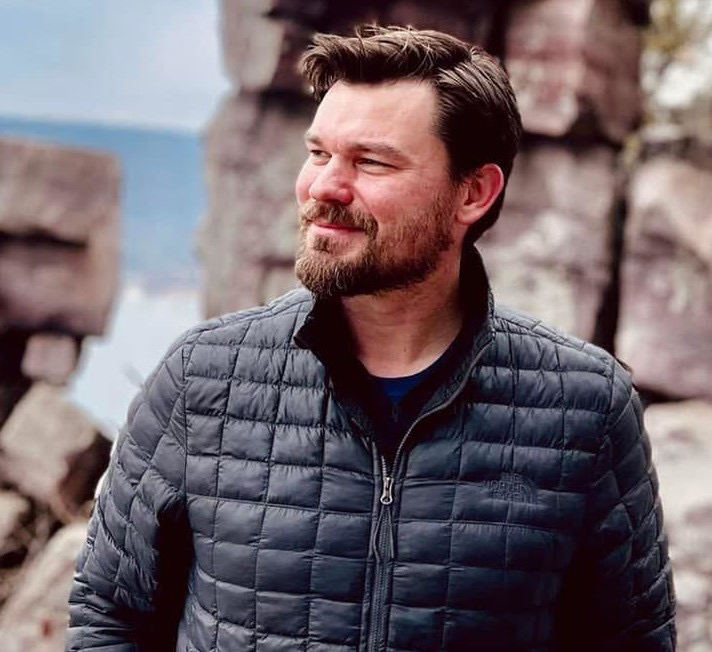
Seth Taft is the Executive Director for the Friends of Wisconsin State Parks; an 501(c)(3) organization that serves as the umbrella to over 65 nonprofit Friends groups throughout Wisconsin that are associated with a state park, forest, and/or trail. The Wisconsin State Park System comprises 50 state parks, 15 state forests, 44 state trails, and endless recreational/natural areas. His role is to connect friends with grants and resources, advocate and education state legislators, and cultivate a sense of belonging to Wisconsin's most beloved public spaces.
One of the major projects of the Thiensville-Mequon Rotary Club has been the City of Mequon Rotary Park, which was officially launched September 17, 1987 marking the fiftieth anniversary of the club's existence.
The site encompasses approximately 95 acres and is located on Highland Road near the Milwaukee Area Technical College's north campus. The Thiensville-Mequon Rotary club donated the site to the City of Mequon in 1991 and has remained actively involved in its development as a recreational resource for residents across the Thiensville-Mequon community.
In 1992, the T-M Rotary was awarded a "Significant Achievement Award" by the President of Rotary International, Rajendra K. Saboo, as a result of 5 years of effort in turning the club's vision for an active use park in the City of Mequon into a reality. District Governor Rick Luedke was so impressed by T-M Rotary's success with City of Mequon Rotary Park that he petitioned Rotary International to present this highest honor. Our club, and District 6270 is deeply honored by this award, as it is rarely awarded. Since the award was presented to our club, many additional improvements have been added to the park, including 2 pavilions and the gazebo, three baseball fields and two playgrounds.
A Letter From Our Leaders:
Dear Friends,
Parks have the power to bring people together. They positively impact a community by promoting economic development, a higher quality of life, and improved mental and physical health. Parks that accommodate all users—not just children, but people of all abilities and ages—are more important than ever.
With a motto of "Service Above Self," the two Rotary Clubs that serve Mequon and Thiensville have improved our local communities for over 100 years. Construction of an All-User Playground is a critical addition to Mequon Rotary Park. With the community's support, Rotary is committed to making it their signature project for all to enjoy.
The decision to pursue an All-User Playground was not made lightly. It was initially identified as a need in the City of Mequon's 2019 master planning efforts. COVID put the project on hold. Since July 2022, a significant amount of time has been spent discussing, studying, planning, and determining that it is sorely needed.
Most of the playground equipment in Mequon parks is over 30 years old. Some of it had already been used when donated. When speaking with other communities about their all-inclusive playgrounds, they overwhelmingly indicated that those playgrounds are their most popular, not just for children with special needs but for all users.
We are excited about this new, state-of-the-art, accessible, fun playground that will enrich the lives of our residents and be a place that Mequon and Thiensville residents can use and be proud of. When asked to contribute, we hope you reply with a resounding "yes" and a generous gift to address this unmet need.
A Message From the Port Washington Rotary President: Our club has arranged a tour of the Vantage Data Centers Lighthouse campus in Port Washington on Wednesday, August 12 at noon. Given the scale of this project and the impact it's having across Ozaukee County and the wider region, I'd like to extend the invitation to your clubs as well. It seemed only right to share the opportunity beyond our own membership.
A few details:
Date and time: Wednesday, August 12, at noon
Location: Vantage Lighthouse campus, Port Washington (exact meeting point to follow)
Vantage requires a confirmed attendee list in advance for site access, so registration is required.
Space may be limited, so before opening registration widely I'd appreciate a rough sense of how many from your club might be interested. If you could gauge interest and let me know, I'll coordinate with Vantage on capacity and then share registration details and the meeting location.
The first District Minute has been uploaded: https://youtu.be/Noi0mFD91so?si=RmjeYlVjhFGZTq08. These will go live on our district YouTube page https://www.youtube.com/@RID6270 every first and third Sunday of the month. Be sure to subscribe and check in regularly for the latest District 6270 information and highlights from clubs across our district!
Martin Van Buren is generally regarded as a below-average, simply “okay” president and is often overlooked for the two presidents who served contiguous to his term. Andrew Jackson and William Henry Harrison typically garner more attention; the former for his controversial presidency and the infamous Indian Removal Act, and the latter for the shortest presidential term in US history.
The inauguration of William Henry Harrison, 1840
Van Buren was the heir apparent to the presidency after a political career culminating with his service as Andrew Jackson’s vice president. Jackson’s support aided Van Buren’s campaign as a member of the relatively new Democratic Party in 1836, leading to his election. However, after a poorly rated presidency that included the “Panic of 1837” economic depression, his 1840 presidential campaign faced considerable opposition. Harrison defeated Van Buren’s run for a second term in 1840 to become the oldest man elected president, and age was a point of contention during his campaign. (Since then, both Ronald Reagan and Donald Trump have been elected in their 70s). Harrison famously delivered a superfluous inaugural address on a frigid day, refusing to wear a coat to demonstrate that despite being 68 years old, he was still robust and fit to serve. He contracted pneumonia during his excessive speech and died a month later.
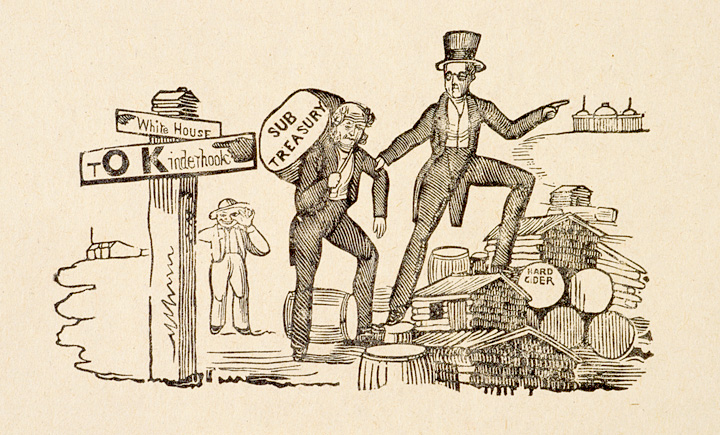
Van Buren’s 1840 campaign is often credited with the origin of the term “OK,” widely popular both then and now; however, the derivation of “OK” is convoluted. Proposed origins of OK range from the Choctaw okeh which holds the same meaning as the modern okay, to the Greek olla kalla, “all good,”to stories of a baker with the initials OK stamping the letters on army biscuits. Allan Metcalf explains in his book OK: The Improbable Story of America’s Greatest Word that OK grew out of a joke written in March of 1839 by editor Charles Gordon Greene in the Boston Morning Post. The joke was that even if a person couldn’t spell “all correct,” they could “o.k.” something to say it was “oll korrect.” OK came out of a time when intellectuals were using wordplay to publish punchy jabs, and abbreviations were becoming popular- precursors to the modern LOL, JK, and even POTUS.
Born in Kinderhook, New York, Van Buren earned the nickname of “Old Kinderhook,” further popularizing the abbreviation “OK.” His Whig opponent, William Henry Harrison, was famous as “Old Tippecanoe” or the “Hero of Tippecanoe” due to his military victory at the Battle of Tippecanoe in 1811. With running-mate John Tyler, Harrison’s campaign song of Tippecanoe and Tyler Too included lyrics criticizing Van Buren, calling him “little.” (Sound familiar?) The song stated, “For Tippecanoe and Tyler too/ And with them we’ll beat little Van, Van, Van/ Van is a used up man.”
OK remained a running theme during the campaign. OK Clubs of Van Buren’s supporters rose up around the country, using the meaning of OK, all correct, to say that voting for Van Buren was giving a stamp of approval. His opponents used the term OK to attack Van Buren, stating that his political ally Andrew Jackson was so unintelligent that he “OK’d” bills during his presidency since he could not properly spell “all correct.” Regardless of the debated origin of OK, Van Buren’s 1840 run certainly helped disseminate the word. OK is used today as nearly any part of speech; as a noun, verb, adjective, interjection, et cetera, and in almost infinite scenarios so that the meaning has a certain amount of ambiguity. Van Buren’s presidency was just OK, or it could have even been considered oll korrect or all correct depending on your point of view, which is ultimately the legacy of Old Kinderhook’s story.